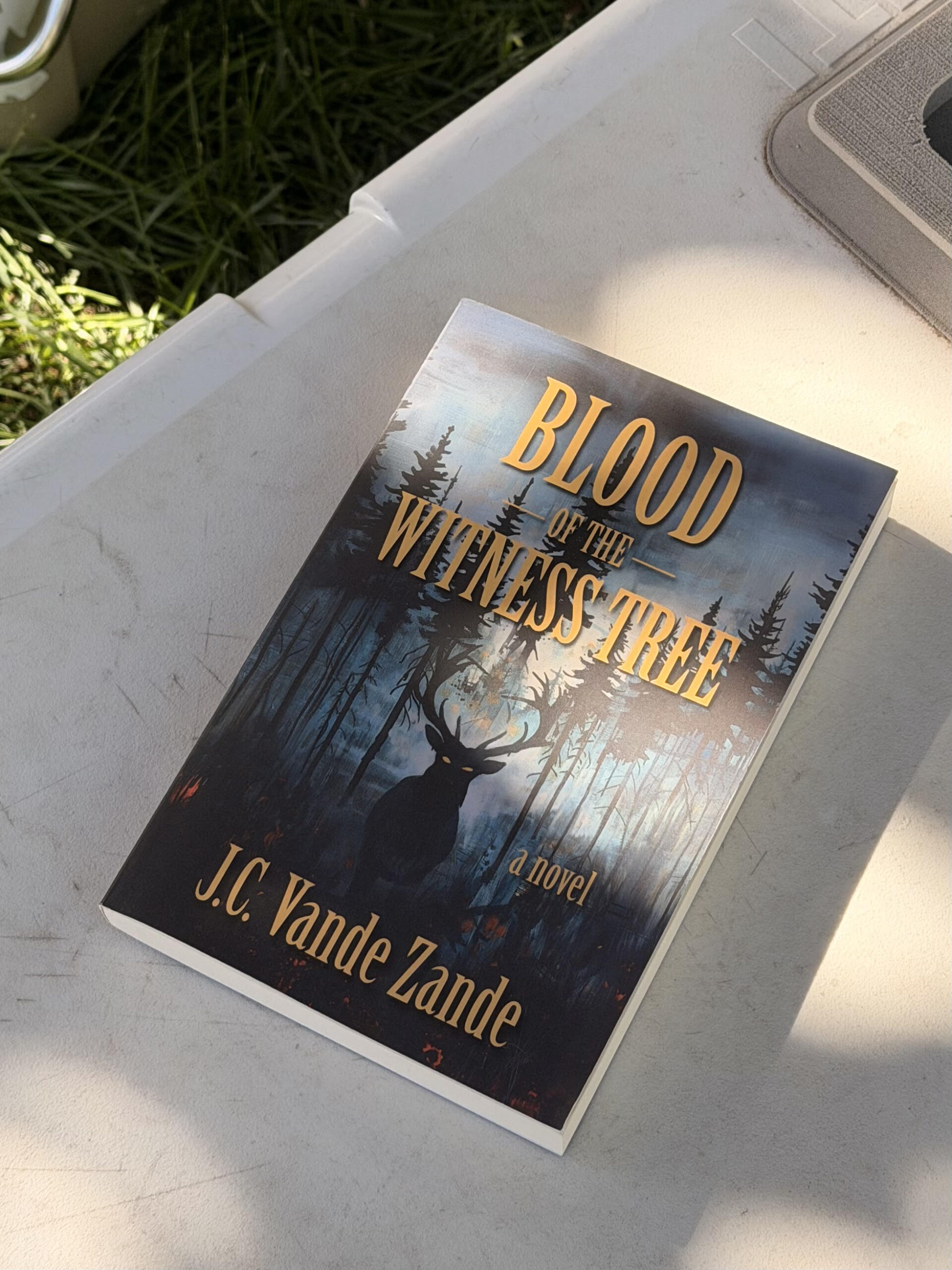
I’ve spent more nights in the Pigeon River Country Forest than I can count—some guiding, some wandering, some just listening to the woods breathe. Anyone who’s spent real time in the PRC knows it’s not just a place; it’s a presence. The forest remembers things. It holds them. Sometimes it whispers them back. So when I picked up *Blood of the Witness Tree* by J.C. Vande Zande, a horror novel set deep in the same woods I’ve called home for decades, I didn’t just read it—I felt it. And I felt it in a way that only someone who’s been out there in the dark, miles from a cell signal, can.
“He closed his eyes for a moment and thought of the life in those depths in the darkness beneath the underside of the tree. How many fish were in there? How big was the biggest? Didi it hold against the bottom, ignoring what drifted by the log’s edge that separated light from the shadow? Did it wait instead for evening with the changes in light and cooler water temperatures? What were the factors involved that either brought a fish to the surface or kept it in the safety of the shadows?”
A Horror Story Rooted in Real Michigan Soil
The book is described as “a true American horror story—born in the woods, steeped in memory, and soaked in dread,” set in the Pigeon River Forest. That’s not marketing fluff. Vande Zande captures the PRC with an accuracy that borders on eerie. The damp hush of cedar swamps, the way fog clings to the river corridor at dawn, the sudden silence when the wind dies and the forest seems to hold its breath—he gets it. He gets the way the woods can feel alive, and not always in a comforting way.
The story follows Isaac Fletcher, who heads into the forest with his teenage son for what’s supposed to be a healing fly‑fishing trip. As a guide, I’ve taken plenty of fathers and sons into those same waters, hoping the river might mend what words couldn’t. I know that impulse well. But in this novel, the river and the woods have their own agenda. Something ancient is stirring—“something that remembers.”
That line hit me hard. Anyone who’s spent time in the PRC knows the feeling of being watched—not by people, but by the land itself. I’ve had nights out there where the hair on the back of my neck stood up for no reason I could name. Vande Zande taps into that primal unease with the precision of someone who’s felt it too.
The PRC as a Character, Not a Setting
Most writers treat the woods as scenery. Vande Zande treats them as a character—one with moods, memories, and motives. The Pigeon River Country is not just where the story happens; it’s why the story happens.
He writes about the forest the way I talk about it to clients who’ve never been here before: as a place that can heal you, humble you, or haunt you depending on what you bring into it. The PRC is 100,000 acres of wild land, and when you’re deep enough in, the modern world falls away. No cell service. No traffic noise. No lights except the stars. It’s beautiful, but it’s also isolating. And isolation is fertile soil for horror.
The book’s atmosphere is thick with that isolation. Reviewers call it “a slow‑burn stunner… quietly supernatural,” tapping into “primal fears of isolation [and] parental guilt.” That’s exactly right. The supernatural elements don’t feel like fantasy—they feel like the logical extension of what the PRC already is: a place where the boundary between the natural and the uncanny is thin enough to slip through.
“Isaac knew that time spent in the woods meant experiencing nature on its terms. His sleeping in the past had been interrupted by families of raccoons rummaging through the contents left atop a picnic table. Another time, he’d woken in the morning to a funnel weaver spider’s web woven in the corner of his tent just above his head. The little, stubbed legs of the arachnid stuck out at the edges of its diminutive abyss. The strangest time perhaps, he and his fishing partner had even had an emaciated cow elk wandering circles through the campground they were in. It carried its head tilted to the side and seemed unaware of their presence. As it turned out, a ranger explained, the animal likely had had a brain worm that blinded it in addition to other neurological effects. Wandering sightless in a nearby meadow, abandoned by the rest of the herd, it had likely followed the sound of their neighbor’s generator up into the campground.”
Fishing as Ritual, Memory, and Vulnerability
Isaac’s fly‑fishing trip isn’t just a plot device. It’s a ritual. A way to reconnect with his son, with the river, and with himself. As someone who’s guided on the Pigeon River for years, I know how fishing can dredge up old memories—good and bad. There’s something about standing in cold water, listening to the current, that strips away the noise of everyday life. You’re exposed. You’re honest. You’re vulnerable.
Vande Zande uses fishing the way good writers use religion: as a lens for reckoning with grief, guilt, and generational trauma. The book is described as “a haunting meditation on family, loss, and the pull of place.” That’s exactly how it reads. Isaac isn’t just fighting whatever ancient force stirs in the woods—he’s fighting the ghosts he brought with him.
And that’s something I’ve seen on the river more times than I can count. The PRC has a way of bringing buried things to the surface.
When the Woods Get Spooky — A Guide’s Perspective
There’s a moment in the book where Isaac realizes the forest isn’t just unsettling—it’s aware. It’s responding. It’s remembering him. That’s the kind of moment that separates real horror from cheap thrills.
I’ve had my own PRC moments like that. Nights when the woods go dead silent. Mornings when fresh tracks appear where no tracks should be. Once, years ago, I was hiking out after scouting a stretch of river near the old elk range. The sun was down, and the woods were thick with that blue‑black darkness you only get in northern Michigan. I heard footsteps behind me—slow, deliberate, matching my pace. I stopped. They stopped. I walked. They walked. When I finally reached the trailhead, whatever it was peeled off into the trees without a sound. I’ve seen shadows along the bank, somehow follow me in the river. Watched a medium sized animal crawl out of a ditch, muddy and oiled, scurry into nothingness.
That’s the kind of unease Vande Zande captures perfectly. Not monsters. Not gore. Just the sense that something old and patient is sharing the woods with you.
Orphan Island and the Echo of Past Horrors
The book ties into past events from *The Dance of Rotten Sticks*, including “a nightmarish encounter with occult forces on Orphan Island.” You don’t need to have read the first book to feel the weight of that history. The past bleeds into the present, just like it does in real forests. Old logging camps, abandoned homesteads, forgotten graves—Michigan’s woods are full of places where stories linger long after people leave.
Vande Zande understands that horror isn’t just what happens now—it’s what happened before, and how it refuses to stay buried.
A Story About Fathers, Sons, and the Places That Shape Us
At its core, *Blood of the Witness Tree* is about a father trying to reconnect with his son. The supernatural elements amplify that emotional core rather than overshadow it. The book is “equal parts emotionally raw and quietly supernatural”. That balance is what makes it powerful.
As a guide, I’ve watched fathers and sons struggle to talk to each other until the river gives them the space to do it. I’ve seen the way shared silence can heal wounds words can’t. Isaac’s journey feels real because it mirrors the emotional terrain of the PRC itself—beautiful, unforgiving, and full of echoes.
The Witness Tree Itself — Symbol, Sentinel, Warning
Without spoiling anything, the Witness Tree is more than just a landmark. It’s a symbol of memory, trauma, and the forest’s long, watchful presence. Trees in the PRC can live for centuries. They’ve seen things. They’ve held things. Vande Zande uses the Witness Tree as a focal point for the story’s dread, grounding the supernatural in something deeply natural.
It reminded me of certain trees I’ve passed on the river—massive, scarred, older than any building in town. Trees that feel like they’re keeping watch.
Why This Book Hit Me Harder Than Most
I’ve read plenty of outdoor‑themed fiction, and most of it gets the details wrong. The rivers feel generic. The woods feel like wallpaper. The characters move through nature without being shaped by it.
*Blood of the Witness Tree* is different. It’s written by someone who understands that the PRC isn’t just a setting—it’s a force. A memory. A witness.
The book’s horror works because it’s rooted in real places and real emotions. The supernatural elements feel like extensions of the land itself. The family drama feels honest. The dread feels earned.
And for someone like me—someone who’s spent half his life guiding people through those same woods—it feels personal.
Final Thoughts — A Haunting, Beautiful, Unsettling Triumph
If you’ve ever felt the woods watching you, this book will get under your skin. Reviewers say exactly that: “If you’ve ever felt the woods watching you, this one’s going to hit hard.” [Goodreads](https://www.goodreads.com/en/book/show/240196493-blood-of-the-witness-tree) They’re right.
‘Blood of the Witness Tree‘ is more than a horror novel. It’s a love letter to northern Michigan’s wild places, written with reverence, fear, and deep understanding. It’s a story about fathers and sons, about grief and memory, about the way the land holds onto the past. And it’s a reminder that the PRC is never just scenery—it’s a witness.
For anyone who knows the Pigeon River Country the way I do, this book feels like coming home to a place you love—and remembering why it scares you.
You can get yourself a copy here: BLOOD of the WITNESS TREE
—