Join the T|N|T Fan Club on Facebook!
True North Trout has a cool new Facebook page.. scroll down and look to the right hand column to join our club at the Evil Empire! We need more minions if we're ever going to have an angling horde. The invasion will start from driftboats!
Trout fishing on local rivers continues to be decent with some days being really good and others, not so much. The recent weather, in my opinion, is to blame for the inconsistencies, a little snow over the weekend, warm sun a few days later, a cold rain shower or two here and there and the bugs and their emergence just hasn’t been overly predictable – who can blame them?
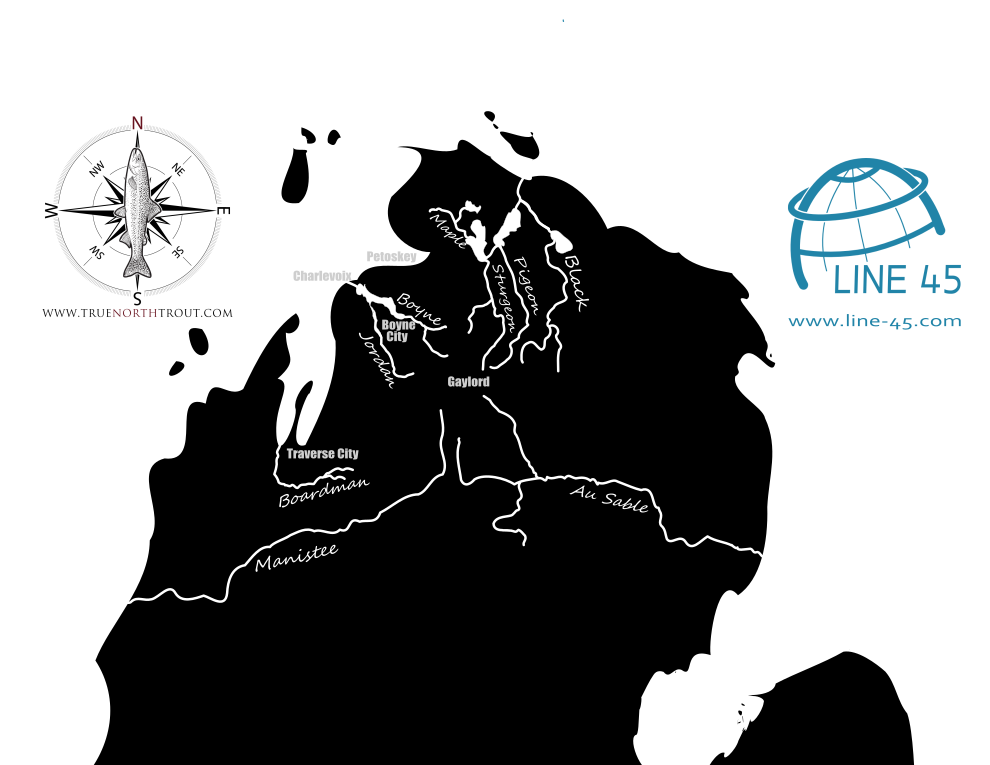
What I am experiencing are: The Upper-Manistee – some Hendricksons (mostly spinners at sporadic times of the day), medium brown stones, a few march browns, black quills/Borchers, caddis, mahoganies and an increase in BWOs. The Manistee below Tippy Dam is offering up some caddis hatches, BWO’s, and midges on top and the nymph bite is getting even stronger with scuds and sow bugs down low and fry patterns fished dead-drift, swung and stripped. The Boardman - Hendricksons and caddis have been emerging. Look for the warmer weather of next week to kick-off good emergences of sulphurs on both rivers which should be really good this year.
When not matching the hatch, the streamer fishing has been producing some nice fish for those looking to put the time in and the cast in the right spot. Water levels are lower and clearer than what is considered ideal, but good fish are still coming to the fly: CF Minnows, sculpins, deceivers and zonker/rabbit strip leeches have been working. The right color and the amount of flash varies with not only the day, but time of day – mix it up until you find what they like.
The cooler weather has had its effect on lake fish too. Bluegill/panfish are shallow in some of the smaller waters, and just into the deeper water on others. The nymph and very small streamer angler has had more success beneath the surface than those fishing on top. Look for that to change soon. Bass in the lakes have been getting active in their pre-spawn mode and the pike have been eating a streamer too, now that they are post-spawn feeding. When lake fishing, look for any weed growth to be a good place to target fish. The carp in the bay which were very “spotty” (not widespread, but concentrated when found) have moved back to the deeper water with a few fish coming into the flats when the sun is bright and the water temp is in the mid-50s. Pay attention to night temps, wind direction and bring your thermometer.
Ted Kraimer is a professional guide and fly tier, owner of Current Works Guide Service, and field editor for True North Trout. His fishing reports will continue to appear in T|N|T and on his website.
This seems to happen more and more these days. A good organism, doing its job in the world, eking out life in its established niche. Suddenly, something goes wrong – conditions change or the organism is transported to a new location. Sometimes death or extinction result, but other times rampant growth occurs, resulting in a perfectly good organism becoming a nuisance. Such is the case with Didymosphenia.
Didymosphenia, or Didymo for short, is a beautiful and rather large diatom. Diatoms are a type of algae that grow on all sorts of substrates in a stream; they produce oxygen during photosynthesis, thereby sustaining aquatic life. Many diatoms have specific habitat requirements and have been used as indicators of water quality over the years. Finding Didymo in a water sample has traditionally meant that the lake or river was oligotrophic: very cold and clean, with very little available nutrients. Finding Didymo today might signal alarm.
Didymo occurs naturally across the northern hemisphere, typically in high altitude streams, but has recently started to flourish in a number of atypical environments. Scientists are monitoring stretches of rivers in Colorado, Idaho, Montana, Wyoming, Oregon, North Dakota, Vancouver Island, parts of Europe, and most recently, New Zealand. Established Didymo populations in some watersheds have completely covered rocks and plants, often for 10-20 km or more, effectively taking over an entire riverbed.
To understand how a microscopic alga can consume a river bottom, consider how Didymosphenia grows. Diatoms are constructed like tiny glass boxes; when they reproduce vegetatively, the frustules (or the lid and bottom of the box) divide. Each frustule produces a new half, resulting in two new ‘boxes’ or complete diatoms. Each time Didymo divides, it also exudes a mucilaginous stalk, which can be hundreds of times the length of an individual frustule. In places where Didymo colonies grow rampantly, the appearance and texture becomes quite gross. “The stuff is really slimy, at least on the top layer,” says Rex Lowe, diatom specialist from Bowling Green State University. “But the stalks are rather tough and cottony when pulled off a rock. When you step on it, the top is slippery but it squishes down, similar to stepping on an outdoor carpet.” Because the stalks are non-photosynthetic, they can take on a whitish appearance. “The stalks make up most of the density of the colony. They dry out almost like paper – in fact, where Didymo colonies have dried out (post high water mark), they look like toilet paper or cardboard along the stream.” The stalks are resistant to decomposition, so there is no odor to the algal mat, but because of the resemblance to toilet paper, it can appear that a river has sewage discharge problem.
Dr. Lowe is currently involved with BioSecurity New Zealand, where Didymo, or ‘rock snot’ as it is called down-under, has launched a significant invasion. Didymo first appeared in 2004 and has since then rapidly colonized ten rivers. How did it get there? More than likely it arrived by trout anglers. “There is just a steady torrent of trout fishermen going over to New Zealand,” says Dr. Lowe. “If they’re from western states and they don’t clean their boots, they are going to be carrying microbes.” New Zealand scientists have taken an extremely aggressive approach to minimizing the spread of the diatom: initially they closed many rivers, actually posting personnel to prevent physical access. Presently, they are considering ways to chemically control the invasion, using chlorine or copper sulfate. “I would think that the most ‘hopeful’ thing is to let it run its course, and then become controlled naturally by a virus or bacteria.” Dr. Lowe compares the New Zealand invasion to a similar event that occurred on Vancouver Island. There, Didymo populations exploded for about 10 years. Since then they have dropped back naturally, not unlike other boom and bust cycles that typify invaders.
But what everyone really wants to know is what is causing Didymo to suddenly bloom? A number of theories have emerged, including increased ultraviolet light and global warming. Dr. Lowe, however, feels that the sudden spread is due to a genetic variant. “On Vancouver Island, the diatom was reported in the late 1800’s; it didn’t explode until the mid-1990’s and their streams have not undergone any dramatic changes. In New Zealand, there wasn’t much diatom growth at all and now suddenly Didymo is there and doing really well.” In other words, Didymosphenia seems to have mutated just enough to radically widen its once narrow environmental window.
Here in the states, Sarah Spaulding of the Environmental Protection Agency is closely monitoring the spread of Didymo. Currently, the diatom seems to be confined to the west, with recent reports confirmed in North Dakota, Oregon, and Wyoming. According to Dr. Spaulding, “There has been little scientific research on the fallout of this invasion, in terms of the insect life and fisheries.” The stalks seem to present most of the problem. As the colonies become dense, fine sediments are trapped in them, excluding typical grazers (i.e., mayflies, caddisflies, etc.). Chironomids seem to like the mats, and data indicate increased populations in streambeds overcome with Didymo. No one has looked at long-term effects on the fisheries however. “The Federation of Fly Fishers has shown great interest in the spread of Didymo,” says Dr. Spaulding. “In fact, they are cosponsoring a symposium with the EPA and the American Fisheries Society.” The symposium will address the science of the diatom, its growth and spread, and its overall impact on the entire watershed.
Didymo has yet to be reported in the Midwest, but an ounce of prevention beats the cure. Fly fishers travel from one stream to another, often tossing wet waders and boots into a plastic bag or storage container. Diatoms and other microorganisms are capable of surviving quite a while, as long as they have some moisture. Since it only takes one live cell to start a colony, the potential exists to transport Didymo to new streams. According to Spaulding, anglers can prevent the spread by cleaning and treating boots and waders. Scrubbing in hot water and then soaking for a few minutes in a bleach solution (1/2 cup in a 2 gallon bucket) will kill the diatom as well as other organisms (think zebra mussels for starters). It is important to not allow the cells to wash down the drain, as then they are directed right into the watershed. Alternatively, boots and waders can be completely dried for at least 48 hours. Any area that can harbor trapped moisture, however, can also harbor the diatom, so chemical treatment is preferred.
For information on the symposium, contact Spaulding.sarah@epa.gov or visit www.fisheries.org/AFSmontana or www.epa.gov/Region8/water. To report suspected Didymo colonies, collect material in a clean, stoppered vial. Send materials to Sarah Spaulding with exact location of collection site (refer to her email for additional instructions).
This Saturday marks the official opener to Michigan’s trout season and it’s streams throughout the state. Just like Nov. 15/opening day is significant to the deer hunter, this Saturday is more than symbolic – it’s your chance to get on water that has been well rested since the end of September and score on some unsuspecting fish.
The warm weather the past seven weeks should make this year’s opener one of the best in years. Water temps are in the 50’s and the fish are out of their post hibernation-funk and eating streamers and some dry flies. The insect activity has been sporadic thanks to the cooler nights of late, but look for black stones, Hendricksons, black caddis, black quills/borcher’s drakes on the Upper Manistee. The Boardman – running cooler – has had some “henies” coming off too, but not many fish eating them. This time of year, insect activity is best when the temps are warmest so look for sun, light winds and mild overnight temperatures – the rest of the time, fish streamers and nymphs.
If you are heading out this weekend, have a box of big streamers to tie onto your sink-tip line if you are looking to score the bigger, more aggressive fish. Be around gravel and riffle areas on your favorite section of water for the best Hendrickson activity; the nymphs call that water home and the spinners come back to it when depositing their eggs. Fish a nymph and or wets – down and across, or, when you see some surface activity or an emergence tie a wet or a nymph behind a dead-drift emerger. The fish haven’t seen much activity for a while on the closed sections so use some stealth when fishing to keep fish happy.
Steelhead fishing is still going, but is winding down. Since it has been such a strange spring for steelhead, who knows what will happen – especially after our next rain. Some fresh fish are still trickling up the Manistee, Betsie, Boardman and Platte Rivers, but in small numbers while drop-back females are slipping back to the big lake. Many people are willing to subject themselves to the cold weather of winter steelhead for a chance at a few fish, but it amazes me that more people don’t pursue drop-back and the remaining fresh running fish this time of year in the warmer weather. With the warmer water, it’s the best acrobats and fighting fish of the year. Lots of Oregon Cheese eggs patterns, larger hex nymphs and steelhead buggers have been working in the deeper water with the small, pale colored eggs, small stones and caddis around gravel. With water temps in the mid 50’s it’s not necessarily a bad time to swing some flies looking for non-spawning fish to eat your bigger presentation of streamers and spey flies.
Often out of the lime-light for fly fisherman are all of the lakes in the Lower Peninsula and the other seasons that share the same opener: Pike, Musky, Walleye and catch and immediate release Bass fishing starts this Saturday, too. See the MI-DNRE for specifics on regulations.
Good luck this weekend and be sure to be considerate to other anglers you encounter on the water – we made it through another winter and opener is another confirmation that spring is here!
Reading water, air, fire, earth it makes no difference….
the language of things sifting through his hands like Braille.
He figures his life is worth at least one river,
an arm worth a single bend,
and the hairs on his head the equivalent of one riffle apiece.
He is ready to dismantle himself if necessary,
to stand at the edge of a chasm of meetings
and toss whatever it is they will trade
for that wildness he covets like blood.
At night he rides the backs of dreams,
watches the chaos under the surface:
the way death moves constantly through the water,
sunlight barely reaching the bottom of dark pools.
When he wakes, he feels parts of himself left behind,
phantom appendages, whatever it was he valued, given away,
just now turning into water,
his mind a bloody stream.
Michael Delp is a writer of poetry, fiction, and nonfiction whose works have appeared in numerous national publications. He is the author of Over the Graves of Horses (1989), Under the Influence of Water (1992), The Coast of Nowhere (1997), and The Last Good Water (2003), in addition to six chapbooks of poetry. His latest work, As If We Were Prey, is now available. He teaches creative writing at the Interlochen Arts Academy and has received several awards for his teaching. More about his work is available at his website.
He seeks the consensus of dark bends,
feeder creeks, the formations of gravel
turned into messages on sand bars.
Where there is sky, he dreams of more.
Where there are politicians he dreams of men with true hearts,
their dark veins pulsing with pure run-off.
He offers himself to the air, is willing to trade his life
for one river, or if necessary, one cedar, one mayfly,
even one pebble dropped from the belly of a glacier.
He uses his body like a sextant, charts the stars at night,
imagines his voice coming from the bottom of the river,
prowls the swamps with his eyes closed, casting into dark pockets,
the fish swarming in the half light seeping from his skin.
He is true only to himself.
He knows no speeches, has no platform.
His eyes are clear pools, his head a seething
universe of emergence schedules,
the secrets of nymphs, that single language
coming from cold springs in the hills,
each one a wild heart pumping the wisdom of iron
into the river.
Michael Delp is a writer of poetry, fiction, and nonfiction whose works have appeared in numerous national publications. He is the author of Over the Graves of Horses (1989), Under the Influence of Water (1992), The Coast of Nowhere (1997), and The Last Good Water (2003), in addition to six chapbooks of poetry. His latest work, As If We Were Prey, is now available. He teaches creative writing at the Interlochen Arts Academy and has received several awards for his teaching. More about his work is available at his website.
What a strange spring, weather wise: It certainly had its effects on the fishing and in some cases helped things, but there are a lot of people in waders scratching their heads.
The steelhead fishing has slowed the past week and last week’s rain didn’t bring in a push of fish like most hoped for. Still, there are some fish moving up and down the Manistee and Betsie Rivers right now but fishing is spotty. Most of the fish are on or near gravel and are skittish to say the least after angling pressure has taught them to be nervous. Targeting drop-back fish has provided some good action and has also produced some fresh fish on their way up to do their spawning thing. I imagine fish will continue to trickle into the river for a few more weeks, just not in the numbers one would expect when looking at the calendar. Eggs in Oregon Cheese/Orange, and in Sockeye, have been the better egg colors with black stones, hex and steelhead buggers for the nymphs. With 50 degree water temps, look for fish to be there one day and gone the next — proving, yet again, that steelhead are predictably unpredictable. One thing you can count on are hard-fighting and jumping fish — thanks to the warm water.
The good news about the warm water and early spring is that the trout fishing has been good. Water levels are about right and the angling pressure is light on certain sections of water that are currently open. Streamer fishing is the method to use the majority of the time right now, giving those well-rested trout a mouthful. Tans, browns, white and olive patterns have been the better colors with some larger baitfish patterns provoking territorial aggressiveness. If you are fishing water stocked with trout, now is the time to fish with patterns that resemble the bait – TA Bunkers, Deceivers, CF Minnows and Fin Clips. Keep an eye on the water’s surface too as there has been dry fly action on the surface with stones and Hendricksons popping off and some fish eating. Look for the dry fly action and hatches to build significantly thanks to the weather forecast.
Ted Kraimer is a professional guide and fly tier, owner of Current Works Guide Service, and field editor for True North Trout. His fishing reports will continue to appear in T|N|T and on his website.
Michigan Trout Unlimited is pleased to announce that an agreement signed Monday will provide for the restoration of the Pigeon River by removing the Golden Lotus Dam located near Vanderbilt, Mich. You have seen us mention this ongoing case in past emails, newsletters and in Michigan TROUT magazine, and you might have seen articles about it in newspapers around the state.
Trout Unlimited (TU), the Pigeon River Country Association, Golden Lotus, Inc. (the owners of the dam) and the Michigan Department of Natural Resources and Environment signed an interim order, resolving litigation from the June 2008 accidental release of sediment from the Golden Lotus Dam which resulted in a fish kill in the river. The MDNRE, TU and PRCA entered into litigation against Golden Lotus following the incident.
“All parties to the litigation have been working towards an agreement that would put aside the litigation and focus resources on helping the Pigeon River. Golden Lotus’ desire the do what was best for the river and its aquatic life was instrumental in reaching this agreement. This agreement will protect the river from similar incidents in the future while allowing it to become healthier than it has ever been,” said Bryan Burroughs, Executive Director of Michigan TU.
The Pigeon River is one of Michigan’s most popular trout streams. Flowing 43 miles from Gaylord to Mullet Lake, the river has been altered by the dam since it was created over 100 years ago. Dams disrupt the natural flow of water, sediment, nutrients and organisms in rivers and often warm water temperatures, past the ideal range for trout and other coldwater fishes. Removal of this dam is expected to greatly improve the trout fishery for nearly 20 miles downstream of the dam. The Pigeon River is home to wild brook trout, brown trout and rainbow trout. “This is a great day for coldwater conservation, our natural resources and the trout in the Pigeon River”, said John Walters, president of the local Headwaters TU chapter.
TU became involved in the litigation to help ensure protection and restoration of the Pigeon River. Negotiations had been underway since 2008. TU has wanted to remove the dam in the river, to improve conditions for trout and to prevent future dam-related events from occurring. TU was able to help provide critical assistance with, and information for this dam removal, which facilitated the negotiation process.
Peter Gustafson, trout angler and past chair of the Pigeon River Country Citizens Advisory Council, provided legal representation for Michigan TU and the Pigeon River Country Association. “Pete provided valuable assistance with the legal proceedings, but his contributions toward facilitating a successful negotiation was truly invaluable,” said Burroughs.
The dam removal planning process will begin immediately, while the actual removal of the dam is expected to be conducted gradually over several years to reduce further impacts on the river. All parties to the agreement will continue working in coordination on the dam removal planning. MITU will continue to provide updates on this project via its website, magazines and emails.
Trout Unlimited is North America’s leading coldwater fisheries conservation organization, with 7,000 members in Michigan and 140,000 members dedicated to conserving, protecting, and restoring North America’s coldwater fisheries and their watersheds.


Stumble Upon
Del.icio.us
Buzz